Available Today: IQ Answers from LighthouseIQ
January 21, 2026
By:
Get the latest insights
Summary: What if you could ask complex legal questions in plain language and get clear, evidence-backed answers from millions of documents in minutes? Introducing IQ Answers.
The zettabyte-sized data problem legal teams contend with today is that even routine matters involve massive document collections, turning what should be straightforward analysis into cycles of manual review. The workload is crushing, and the personal toll is real.
You’ve likely been inundated by marketing materials promising that generative AI can solve these challenges.
But the problem with many AI tools used in legal work today is they have no guardrails around where they source their answers, nor limits to how many “chat” style questions you can ask in a single session. As the AI’s context window degrades over time, large language models struggle to retain context, and extended back-and-forth chat can lead to drift, producing answers that are partially correct or entirely hallucinated.
Introducing IQ Answers
IQ Answers changes this dynamic. Unlike other genAI apps, IQ Answers only references the data you ingest, so the answers you receive are completely grounded in only those documents. IQ Answers also operates on just one question at a time for each result, so the context lens is only focused on the question you’ve asked in that session. It can encode, retrieve, and analyze any data type as long as there is document text.
This framework means you can point IQ Answers at any investigative task for which you have a document corpus. In Early Availability, we saw users turn to IQ Answers for:
- Internal investigations to identify inappropriate behavior or wrongdoing, detect trade-secret theft or IP misuse, or check on regulatory exposure
- Inbound production review for evidence of fraud or financial misconduct, environmental safety compliance, or to prepare witnesses for deposition
- General fact-finding related to topics including regulatory response, labor, product, and safety disputes
Opening the Black Box
After you ask IQ Answers a natural-language question, the platform runs a three-step process that identifies relevant documents, surfaces exemplars, and synthesizes a grounded response. IQ Answers is not a black box.
Here’s how it works:
Step One: Identification & Interpretation
What Happens:
IQ Answers interprets natural-language questions using legal-tuned models that understand intent, not just keywords. It identifies concepts, entities, and relationships to avoid surface-level matching and ensure the system understands what the question means, not just what it says.
Why It Matters:
This early semantic precision mirrors a legal associate’s first step in analyzing a research question: clarifying intent. By replacing keyword matching with deep language understanding, the platform scans large, encoded document sets to identify the documents most likely to contain relevant answers.
Step Two: Retrieval
What Happens:
After interpreting the question, IQ Answers uses a multilayered retrieval approach combining predictive relevance scoring, semantic similarity across normalized documents, and context-preserving retrieval. It then automatically narrows results to the document sections with the highest evidentiary value, filtering and prioritizing exemplar candidates.
Why It Matters:
Where many tools stop at superficial similarity or top results, IQ Answers goes deeper by surfacing the most substantively responsive text, not just what is “close enough.” This approach replicates the intensive work of manual document review, reducing effort while increasing accuracy and defensibility.
Step Three: Synthesized Response
What Happens:
Once relevant evidence is identified, IQ Answers synthesizes it into a clear, cohesive answer by consolidating key findings, identifying patterns and themes, and generating a citation-supported narrative. Each response includes highlighted source text and exemplar documents for further evaluation.
Why It Matters:
IQ Answers produces evidence-backed summaries that traditionally require hours of manual review. Every statement remains traceable to primary documents, giving attorneys confidence that conclusions reflect the actual record. It’s the difference between a stack of potentially relevant documents and a polished interpretation.
Practical Impact
The steps described reflect significant complexity behind the scenes. By coordinating predictive retrieval with generative synthesis, IQ Answers delivers early intelligence without sacrificing explainability or trust. In fact, Early Availability users report reducing time-to-signal by up to 95%, reaching key facts in hours instead of days.
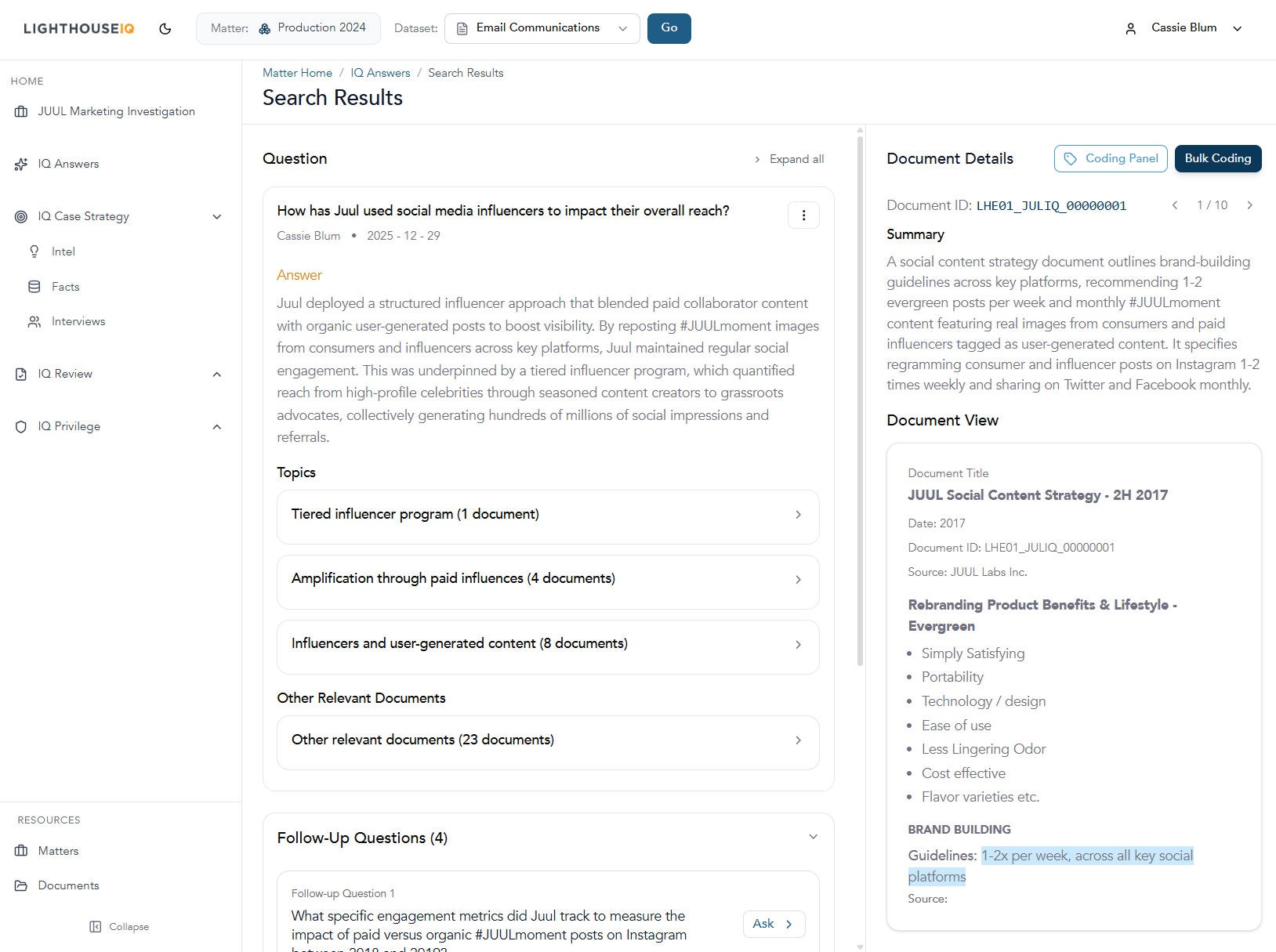
For users, the experience is simple: after an average three-minute load time, you receive a clear answer to your original, plain-language question. Along with a memo-style summary, IQ Answers surfaces key topics, the documents that support each finding, and automatically generated follow-up questions to guide next steps.
Try IQ Answers, Risk Free
We’re thrilled to introduce IQ Answers and confident it will quickly become an essential part of your legal workflow. For a limited time, you can trial IQ Answers risk-free and see how it brings clarity and insights to your data.
About the Author
.png)