orange slanted line

Videos

Explore our latest videos featuring real-world success stories, expert interviews, and innovative solutions at the intersection of legal strategy and cutting-edge technology. From AI-powered review breakthroughs to Microsoft implementations, these videos offer a front-row seat to how we help legal teams navigate complexity with clarity and confidence.

Thank you! Your submission has been received!
Oops! Something went wrong while submitting the form.
March 4, 2026
Solution
Woman in black standing at a wooden desk with a laptop in a modern, minimalist office space.
ai-and-analytics, lighthouseiq

Demo: IQ Answers

Imagine you are an attorney general suing a pharmaceutical company that manufactures a synthetic opioid spray and you're alleging racketeering. You've received 1.5 million documents in production and your team has three weeks before the next case management conference. Traditional review would have meant that you would spend months and likely millions of dollars to interrogate your data. Let's see what IQ Answers can do in the next several minutes. First off, I'm gonna just ask general questions within my dataset to get a sense of what was going on with this product and who it was prescribed for and what was happening with those prescriptions. So I'm typing a question about that generally to see what that returns for me. You'll notice here at the end of the query that you get an overall answer, but you also get topics surfaced for you along with citations that match each of these topics that highlight the particularly important parts of the document that can help lead you to the conclusions that are surfaced for you with IQ Answers. So here we see that this was a spray that was approved for breakthrough cancer pain and that that was the FDA intent of the approval. But what I'm also seeing in these topics that is being surfaced for me is that a lot of off-label prescription for non-cancer pain is apparently going on with this product. And I can tell that from these particular documents that I've clicked on here along with the citations where I'm seeing a hundred plus prescriptions a month that are off label. Well that's interesting. Now I'm also seeing that the salesforce has been explicitly instructed to prioritize high volume opioid prescription writers regardless of their specialty and regardless of what's happening with that prescription. And I can click into the documents and see that the volume is what is driving here. And then I also can look and see that there's been awareness internally that the approved indication from the FDA is not actually matching the patient population. So that's very interesting. It seems like we definitely have some use here that it was not intended, and I could figure that out in about 30 seconds in IQ Answers. I have the foundation. So, if the drug is approved for cancer pain, but the company is deliberately targeting non-cancer patients, that's definitely a gap from the FDA approval. And so, let's understand how they're going about making this happen. How are they getting doctors to keep writing these prescriptions? I'm going to go ahead and ask an additional question of IQ Answers to figure out what they're doing to get this volume of prescriptions written. And in particular, I noticed that there was something about speaker engagements that they were doing with doctors. So I'm going to ask about those speaker engagements. And you'll see here that basically the speaker engagement program was a way for them to pay doctors for prescriptions. I can see that they were tracking the ROI of those speaker payments as compared to the amount of prescriptions a doctor was writing. And I can also see from the documents and the citations that if they did not feel that a doctor was writing enough prescriptions, they were no longer part of these speaking events and, and thus paid through these speaking events. I also see these speaking events are not really genuine educational activity and it looks like the company was aware of this and was terminating doctors when they were not writing enough prescriptions to satisfy the amount of money that they were giving the doctors. So this all does not look very great for them in terms of how these programs were essentially bribery of these doctors. So if they're bribing the doctors, that still doesn't answer for me what's happening with the insurance companies. The product costs thousands of dollars a month and insurance companies wouldn't just approve that without any questions. So Vantage clearly needed a way to get these insurers to pay. Let me ask about that. I'm gonna type in a question about their programs to deal with the insurance companies and the way in which they instructed their employees. All right, so now I see in my answer that they had created what was called a Vantage Reimbursement Center. That was essentially their way of tracking the approvals from the insurance companies. And it looks like from the topics that's being surfaced here, that they were also using it as a vehicle to instruct their staff on how to deceive the insurance companies. In particular, here you can see in this document where they talk about using particular types of language, lingo, or diagnoses to get the insurance companies to approve the use of these drugs for the written prescriptions. But it also looks like they know that these are false statements that are being made when they are talking with the insurance companies. You can see here they're tracking and they want a 100% authorization success rate. So they're essentially giving all of their employees the way to beat the system, to cheat the insurance company, and to get them to approve something under false pretenses. So I now have two parallel fraud streams that are emerging here. One to bribe doctors to write prescriptions, one to deceive insurance companies to pay. For a RICO case, I also need to know that this was coming directly from management and from the top. So let's see if I can find that out in the dataset and ask a question about that to help me win my conviction. Alright, so now I'm gonna ask in particular, what evidence do we have that the CEO knew about this speaker program and this insurance program? Now that I'm asking this of the documents, what I can see here that is surfacing is that in fact the CEO did have direct knowledge and there's multiple documents that substantiate this. And in particular you can see this one here where he personally directs a speaker fee increase that is tied to prescription volume. In this document, you would have him talking about different tiers of speaker programs and that someone is no longer going to be invited to be a part of these speaker programs if they are not writing a certain amount of prescriptions. There's one here that surfaces a document where a hundred percent of the authorization success rate is something that he is directing and he's also calling for in the data. You also see here that I have additional follow up questions that I can be asked that are being surfaced by IQ Answers that will help me investigate and interrogate each one of these particular questions and the information I found up in these questions. But overall, it looks like I, in a matter of minutes, have been able to find key documents and important fact timelines that help me substantiate my case and know that I have a good chance of success moving forward and make me feel set up really well for my next case management conference.
March 4, 2026
Interview
Man in gray suit and glasses speaking to a woman in a pink blazer in an office setting.
ai-and-analytics, lighthouseiq

LighthouseIQ Testimonial with Karl Gunderson from Kirkland & Ellis

Hi, Karl. Hi Stacy. How are you doing today? Good. It's good to see you. Good to see you too. Thanks for spending a little time with us today. Why don't you start out by telling us a little bit more about your role at Kirkland & Ellis and the types of matters that you handle? I'm a partner at Kirkland. My practice really involves the intersection of traditional discovery, preparing documents for production, meeting discovery obligations, and the like, and preparing case strategy, digging into the facts, understanding what those documents all show largely in the mass tort context. So large, very high-value litigation where facts and understanding the facts is really important. Well, so you just talked a little bit about case strategy, so I'd love to hear more about how you've used IQ Case Strategy, As part of litigation, it's really important that we understand what's in the materials, especially early on in the case. It's important to develop case strategy that's based on the actual evidence, based on the actual facts. And then we've, for a long time, been partnering with the Lighthouse team and members of the Lighthouse team to help us weed through, cull through the vast amount of material that often gets collected and produced in a case to really focus on what matters. It's important to be able to cull through those and really develop case themes, understand how particular issues are addressed in the documents, and then really leverage that information to be able to build out case themes, case arguments, develop our strategy for the case. And I think you've used IQ Case Strategy for depo prep in the past. We've actually, in a number of our cases, have really been able to leverage the deposition preparation to have our team focus on the substance of the case. Not spending time reading through a hundred thousand documents produced for custodian, but, focusing on the 100, 200, 300 that really matter the most for that person. That allows our team to focus on the substance as opposed to trying to figure out where in the vast universe of documents out there, that information is. That's great. So maybe touch a little bit on how AI is changing how you handle your client work at Kirkland. Yeah, it's a really exciting time, I think, for the entire field. I literally started in 2010 working on deposition prep, where I had partners who printed off tens of thousands of documents on hard paper and we would sift through them, flipping through them, and putting sticky notes on them. Since then, we've come a long way. The technology we have, especially with the evolving AI technologies, allows us to do more. More work and more effectively. Right by, early on in a case, understanding what the materials are, what the issues are, what the evidence shows, what the document shows, we're able to build out better case strategies that help our clients achieve their goals in litigation. So now that we've rolled out the full suite of applications under LighthouseIQ, I'm curious, beyond IQ Case Strategy, do you see yourself using some of the other tools that we've rolled out? We really do. We've really appreciated the Lighthouse IQ Case Strategy system and method for allowing us to do our work most efficiently and effectively for our clients. That said, I think with the advent of all the AI technologies and the implementation of those into the Lighthouse suite of tools that we've been talking about, we're really, really excited to leverage those materials and do more with them. In particular, the IQ Answers. We're really excited to, to try out on our next case to really help our teams and allow our teams to leverage the information that we're able to glean most quickly from, again, a large set of documents. That's great. Karl, thank you so much for spending time with us today. We really appreciate your partnership. Absolutely. Thank you, Stacy.
March 4, 2026
Interview
Man in suit and woman in pink dress seated on chairs facing each other with a small table and plant between.
lighthouseiq, ai-and-analytics

LighthouseIQ Testimonial with Bryan Marra from Arnold & Porter

Hear how Bryan Marra of Arnold & Porter uses IQ Case Strategy to get to insight faster. Hi Bryan. Hey Stacy. Good To see you. Why don't we start out by just sharing a little bit about your role at Arnold & Porter and the, the types of matters that you handle? So my practice focuses on merger investigations, the second requests, antitrust conduct investigations from the government and also merger litigation and other antitrust litigation. My specialty is really driving the eDiscovery process, um, helping clients use technology to drive more efficient outcomes for them in eDiscovery and complying with these government requests.Why don't You share a little bit about your use of LighthouseIQ, how it's helped you with your clients? Sure. So I used IQ Case Strategy. It was an antitrust litigation and we were facing trial in federal and state court in a matter of months. It was a very aggressive deposition schedule. We had over 30 depositions coming up in a matter of weeks, and we had a production population of over 23 million documents to look through.So how are we gonna tackle that? We could have done this the old fashioned way, hired an army of contract attorneys or used firm attorneys to basically sift through millions of documents, maybe use search terms to winnow it down, but then look at the results. It would've taken a long time, but instead we used IQ Case Strategy. So we worked with a small team of experts, linguists technologists, and we trained them on basically what they were looking for in terms of documents, what the case themes were about the witnesses. And they started delivering documents to us in a week. They kept up a weekly schedule basically to keep up with the depositions.They ultimately did depo prep kits for over 30 depositions and it worked well. I mean, out of 23 million documents, they surfaced thousands of the key documents and they surfaced them early enough for us to get insights and use them for prep in advance before the depositions. You mentioned using linguists and our Lighthouse team. How did pairing Lighthouse expertise with our LighthouseIQ technology help have a better outcome for you? The team we worked with, they basically developed classifiers and linguistic models, uh, using your technology to essentially identify key documents and it ended up being a really a seamless process. I mean, we thought the documents they came up with were relevant and were key documents and we thought it was an excellent use case.Maybe share a little bit what was the biggest impact of using LighthouseIQ? I mean, it was definitely the cost and time saving that was involved. I mean, we basically avoided having to do a massive document review effort, which would've cost the client a lot of money. And so by using this technology, we were able to short circuit having to do that and do things in a more efficient and focused way to get actionable intelligence that we could use, um, right away with our depositions and for the litigation strategy. So now that we've rolled out other applications, I know you've used some of them, but what are your overall thoughts of like using LighthouseIQ more broadly in the future? Yeah, I definitely see use cases to use more of LighthouseIQ technology.I mean, how I use AI is really to make eDiscovery more efficient for my clients to save money, to do things in a more focused way. And I can see use cases for IQ Answers. I'm, I'm looking forward to using that application for early case assessment to help clients find out what's in their documents at an early point to help focus the case strategy ahead of time. Maybe share a little bit more about how early insights really helps you and your teams. Definitely. So in merger investigations, finding out what's in your documents at an early point can be crucial.Oftentimes you produce like a million documents to the government and you don't really know what's in them ahead of time. But if you can know what's in your documents at an early point, it can really help you drive case strategy ahead of time. I Know you've used it on some large matters, but think about how, how would you use it on small matters or how you're thinking about the use of AI in the future. So I think size isn't really the main factor. I mean, clients are always looking to save money and they're always looking to find out more intelligence about their documents at an early point. And I think even in smaller matters, smaller investigations, this could be a way to see what's in your documents at an early point to drive case strategy.I look forward to using IQ Answers to do that, what I've seen of it that looks great and, and I think will help me in my practice for my clients. That's Great. Why don't you share a little bit about how you think about the use of AI in your practice? Really, AI helps you move from broad-based review solutions towards more focused actionable intelligence. And that's what we're trying to do in my practice to help clients use technology to find out more about their documents ahead of time to get through, you know, what would've been a massive costly undertaking much faster and more efficiently by using ai. And that's how I see my role is sort of being someone that uses this technology to drive these outcomes for my clients.Thank you so much for your time, Bryan. Really a pleasure to have this conversation with you. It was great speaking with you.
March 4, 2026
Webinar
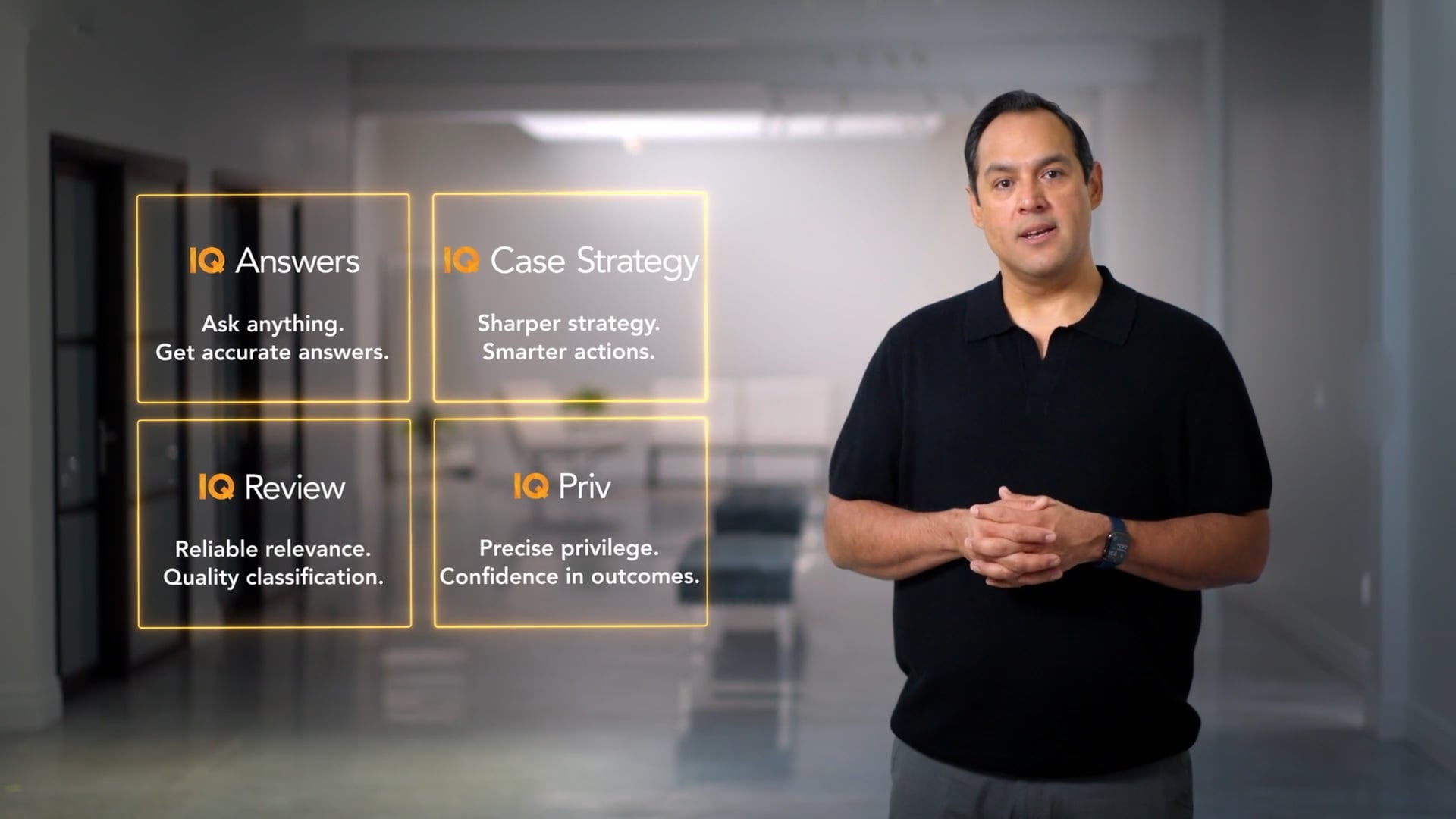
Man in black shirt presenting four IQ service boxes about answers, strategy, review, and privilege.
ai-and-analytics, lighthouseiq, lighthouse-client-success

LighthouseIQ: Delivering Impact Now. Defining Legal’s Future.

In every matter, there's a moment that changes everything. The moment information turns into understanding the moment, every decision becomes clearer, faster. The moment you can act with confidence, get to that moment quicker with LighthouseIQ, where intelligence meets performance. Hello and welcome. I'm Stacy Ybarra, Chief Marketing Officer at Lighthouse. Earlier this year we introduced LighthouseIQ, our eDiscovery platform, designed to bring earlier insight and greater control to the discovery lifecycle. Today you'll hear directly from clients putting that approach into practice. You'll also see how it helps legal teams stay flexible, whether they're managing complex matters today, or planning for how review platforms will evolve. To ground in how LighthouseIQ was built to support that flexibility, I'll turn it over to Iram Arras, our head of product and engineering. Iram. Thanks, Stacy. I'm Iram Arras, Senior Vice President of Product and Engineering at Lighthouse. My role is to make sure what we build actually works in the real world - not just in a controlled demo, but on live matters at scale when timelines are tight and consequences are real. Before joining Lighthouse, I spent time at Microsoft where the teams I worked with built Purview eDiscovery, which is used by many of the largest organizations in the world. That experience shaped how I think about this space. Legal technology has to be scalable, dependable, and defensible, and designed for pressure. Otherwise it doesn't matter how impressive it sounds. Since LighthouseIQ launched, a lot of questions I've been hearing are less about what it is and more about how it's different and why it was built the way it was. Lighthouse has been working with large language models and applied AI well before this technology became a headline. That gave us time to focus on the work behind the scenes, tuning models to handle real world scale, dialing in precision through continuous refinement, and building the safeguards that make them trustworthy in practice. The result is a platform teams can rely on day in and day out. From a product perspective, LighthouseIQ is a purpose-built eDiscovery intelligence platform with two core parts: IQ Applications that address specific high value workflows and IQ fabric, which is the foundation that weaves everything together. The goal is straightforward, help legal teams understand their data faster, make better decisions and control costs without compromising quality or defensibility. Today LighthouseIQ includes four core production grade applications designed for scale, accuracy, and consistency. Each built specifically for real eDiscovery workflows and already in use on complex matters. They are: IQ Answers, which allows teams to ask direct questions of their data and get immediate reliable answers; IQ Case Strategy helps translate insight into action; IQ Review delivers high quality relevance and classification across large data sets with speed and repeatability; IQ Priv provides precise privilege identification and logging, giving teams confidence in their outcomes. Underneath all of this is IQ Fabric, which brings together three core capabilities: Processing that standardizes data at massive scale while preserving fidelity; Cognition that helps interpret content and surface meaningful insights; Orchestration that connects workflows, tools and teams so work moves forward smoothly. Together these capabilities turn raw data into real action at scale and speed modern eDiscovery demands. That's the thinking behind LighthouseIQ and how we're seeing it used today. To illustrate how this works practice, Stacy sat down with Bryan Marra from Arnold & Porter to talk about how they use LighthouseIQ. Hi Bryan. Hey Stacy. Good to see you. Why don't we start out by just sharing a little bit about your role at Arnold & Porter and the types of matters that you handle? So my practice focuses on merger investigations and second requests, antitrust conduct investigations from the government and also merger litigation and other antitrust litigation. My specialty is really driving the eDiscovery process - helping clients use technology to drive more efficient outcomes for them in eDiscovery in complying with these government requests. Why don't you share a little bit about your use of LighthouseIQ and how it's helped you with your clients. Sure. So I used IQ Case Strategy. It was an antitrust litigation and we were facing trial in federal and state court in a matter of months. It was a very aggressive deposition schedule. We had over 30 depositions coming up in a matter of weeks and we had a production population of over 23 million documents to look through. So how are we going to tackle that? We could have done this the old fashioned way - hired an army of contract attorneys or used firm attorneys to basically sift through millions of documents, maybe used search terms to winnow it down, but then look at the results. It would've taken a long time. But instead, we used IQ Case Strategy. So we worked with a small team of experts, linguists, technologists, and we trained them on basically what they were looking for in terms of documents, what the case themes were about the witnesses, and they started delivering documents to us in a week. They kept up a weekly schedule, basically, to keep up with the depositions. They ultimately did depo prep kits for over 30 depositions and it worked well. Out of 23 million documents, they surfaced thousands of the key documents and they surfaced them early enough for us to get insights and use them for prep in advance before the depositions. You mentioned using linguists and our Lighthouse team. How did pairing Lighthouse expertise with our LighthouseIQ technology help have a better outcome for you? The team we worked with, they basically developed classifiers and linguistic models using your technology to essentially identify key documents and it ended up being a really a seamless process. We thought the documents they came up with were relevant and were key documents and we thought it was an excellent use case. Maybe share a little bit, what was the biggest impact of using LighthouseIQ? It was definitely the cost and time saving that was involved. I mean, we basically avoided having to do a massive document review effort, which would've cost the client a lot of money. And so by using this technology, we were able to short circuit having to do that and do things in a more efficient and focused way to get actionable intelligence that we could use right away with our depositions and for the litigation strategy. So now that we've rolled out other applications, I know you've used some of them, but what are your overall thoughts of using LighthouseIQ more broadly in the future? I definitely see use cases to use more of LighthouseIQ technology. I mean, how I use AI is really to make eDiscovery more efficient for my clients - to save money, to do things in a more focused way. I can see use cases for IQ Answers. I'm looking forward to using that application for early case assessment to help clients find out what's in their documents at an early point and to help focus the case strategy ahead of time. Maybe share a little bit more about how early insights really help you and your teams. Definitely. So in merger investigations, finding out what's in your documents at an early point can be crucial. Oftentimes you produce like a million documents to the government and you don't really know what's in them ahead of time, but if you can know what's in your documents at an early point, it can really help you drive case strategy ahead of time. I know you've used it on some large matters, but think about how would you use it on small matters or how you're thinking about the use of AI in the future. So I think size isn't really the main factor. Clients are always looking to save money and they're always looking to find out more intelligence about their documents at an early point. And I think even in smaller matters, smaller investigations, this could be a way to see what's in your documents at an early point to drive case strategy. I look forward to using IQ Answers to do that. What I've seen of it, it looks great and I think will help me in my practice for my clients. That's great. Why don't you share a little bit about how you think about the use of AI in your practice? Really, AI helps you move from broad-based review solutions towards more focused actionable intelligence and that's what we're trying to do in my practice - to help clients use technology to find out more about their documents ahead of time to get through what would've been a massive costly undertaking much faster and more efficiently by using AI. And that's how I see my role, is sort of being someone that uses this technology to drive these outcomes for my clients. Thank you so much for your time, Bryan. Really a pleasure to have this conversation with you. It was great speaking with you. Wow, that was a great conversation. What Bryan described is a model where intelligence comes first, giving your team flexibility before committing to full review. Iram, help us understand how LighthouseIQ was designed to support that approach as platforms continue to evolve. Customers are rightly asking two related questions: What happens with the retirement of Relativity Server in 2028? How will they reduce risk when changing something as central as a review platform? Our answer is straightforward. We reduce this risk by moving intelligence earlier in the lifecycle. So the choice of review platform matters far less than it does today. LighthouseIQ is designed to manage this transition seamlessly. It does not force workflow changes and it does not require customers to retool how they operate. Matters continue to move through LighthouseIQ without a dependency on Relativity Server because the platform is not tied to any single review tool or even to the assumption that documents must be reviewed in a traditional system at all. That flexibility is deliberate. Customers can choose how and where they review documents, if they choose to review them. LighthouseIQ sits above those decisions, providing consistent intelligence regardless of the tools underneath. And to be clear, we remain fully committed to Relativity and will continue to offer RelativityOne as a review option when it's the right fit for a matter. What fundamentally changes is where value is created. That shift is what gives customers more control, more optionality, and far less risk as the ecosystem evolves. With that context, it's more meaningful to hear how this plays out in practice. So next you'll hear directly from Eric Wieder at Baker Botts about how LighthouseIQ is helping their teams navigate these changes and deliver better outcomes on real matters. Hi Eric. Thank you so much for joining us today. I'd love to just hear a little bit about your role at Baker Botts and the type of matters that you oversee. Absolutely. So I am Senior eDiscovery Council at Baker Botts. I've been working in the eDiscovery industry for over 20 years and my role is across the spectrum of the EDRM from collection through production with a focus on review and I've managed many large second requests, multi-district litigation, both civil and criminal cases. I wanted to start out talking about Relativity and the announcement of Server going away in January, 2028 and curious, how does that operationally affect your team and how you think about eDiscovery? So in terms to the transition from Server to RelOne, we're not looking to replace Relativity. We're looking for an AI platform that will extract intelligent data from our clients and seamlessly integrate into Relativity for the benefit of our matter teams. This is what LighthouseIQ does. So tell me a little bit more, expand on that, on how LighthouseIQ will help you with that transition. LighthouseIQ gives us more control over when and how we're going to review the data. It used to be you collect the data and you review it linearly. LighthouseIQ gives us the chance to break it up into parts and review in a prioritized way to the benefit of the case. You've used IQ Priv for some of your cases. Can you share a little about that experience and how it's helped you? Yeah, so we have used the GenAI component of IQ Priv to assist us with our privilege log. As you know, the burden of preparing a privilege log is costly and expensive for our clients. We've been able to use the GenAI tool to more efficiently review documents and then perform a heavy QC so that we could submit a log that is less likely to be contested by the regulators. I understand you've used IQ Answers for some of your matters. Can you just elaborate a little bit more on how you've used it and how it's helped support your team? We have used IQ Answers on two different matters. One a second request, a second one a criminal litigation. In both instances, IQ Answers was very helpful in getting to the question of particular issues quicker than you would normally do just searching a Relativity database. Using an iterative process, we were able to get to the answer for the matter team in a short amount of time. Eric, it's been great spending time with you today. Thank you so much for sharing your experiences with us. Really appreciate you and appreciate the partnership with Lighthouse and Baker Botts. My pleasure, thank you. Wow, another insightful conversation. What Eric just described reinforces that this isn't about swapping platforms, it's about moving intelligence earlier so your teams are much less dependent on the review tools, or norms, at any one point in time. Iram, as you look ahead to 2028 and beyond, bring this all together for us. What does this shift really mean for legal teams as we look ahead to the future? Thanks, Stacy. What it comes down to is when legal teams get clarity. What you heard from Eric around IQ Answers is about getting meaningful insight earlier, while there's still time to shape strategy and make better decisions. When teams understand their data sooner, they can narrow scope, focus on what actually matters, and move forward with a far more confidence. That early clarity changes everything that follows. Decisions are more deliberate, costs are easier to control, and teams spend their time acting on insight instead of searching for it. That's the value of early intelligence and that's the direction we're building toward with LighthouseIQ. Hi Karl. Hi Stacy. How are you doing today? Good. It's good to see you. Good to see you too. Thanks for spending a little time with us today. Why don't you start out by telling us a little bit more about your role at Kirkland & Ellis, and the types of matters that you handle? Yeah, I'm a partner at Kirkland. My practice really involves the intersection of traditional discovery, preparing documents for production, meeting discovery obligations and the like, and preparing case strategy, digging into the facts, understanding what those documents all show largely in the mass court context. So large, very high-value litigation where facts and understanding the facts is really important. So you just talked a little bit about case strategy, I'd love to hear more about how you've used IQ Case Strategy. In litigation, it's really important that we understand what's in the materials, especially early on in the case. It's important to develop case strategy that's based on the actual evidence, based on the actual facts. We've, for a long time, been partnering with the Lighthouse team and members of the Lighthouse team to help us weed through, cull through, the vast amount of material that often gets collected and produced in a case to really focus on what matters. It's important to be able to cull through those and really develop case themes, understand how particular issues are addressed in the documents, and then really leverage that information to be able to build out case themes, case arguments, develop our strategy for the case. And I think you've used IQ Case Strategy for depo prep in the past. Yeah, and we've actually in a number of our cases, really been able to leverage the deposition preparation to have our team focus on the substance of the case. Not spending time weaving through a hundred thousand documents produced for a custodian, but, focusing on the 100, 200, 300 that really matter the most for that person. It allows our team to focus on the substance as opposed to trying to figure out where in the vast universe of documents out there that information is. That's great. So maybe touch a little bit on how AI is changing how you handle your client work at Kirkland. Yeah, it's a really exciting time, I think for the entire field. I literally started in 2010 working on deposition prep where I had partners who printed off tens of thousands of documents on hard paper and we would sift through them, flipping through them and putting sticky notes on them. Since then, we've come a long way. The technology we have, especially with the evolving AI technologies, allows us to do more, more work and more effectively. Early on a case understanding what the materials are, what the issues are, what the evidence shows, what the document shows. We're able to build out better case strategies that help our clients, achieve their goals in litigation. So now that we've rolled out the full suite of applications under LighthouseIQ, I'm curious, beyond IQ Case Strategy, do you see yourself using some of the other tools that we've rolled out? We really do. We've really appreciated the IQ Case Strategy system and method for allowing us to do our work most efficiently and effectively for our clients. That said, I think with the advent of all the AI technologies and the implementation of those into the Lighthouse suite of tools that we've been talking about, we're really, really excited to leverage those materials and do more with them. In particular, IQ Answers, we're really excited to try out on our next case to really help our teams and allow our teams to leverage the information that we're able to glean most quickly from, again, a large set of documents. That's great. Karl, thank you so much for spending time with us today. We really appreciate your partnership. Absolutely. Thank you, Stacy. As we shared in January, we made IQ Answers available as a risk-free trial. IQ Answers is built on a simple promise: ask anything, get accurate answers. It allows teams to extract insight immediately before committing to a full review. In just the past few weeks, dozens of customers have already applied it to millions of their own documents. To show you how that works in practice, I'd like to bring in Cassie Blum, our Senior Director of AI and Analytics. She'll walk through a brief demonstration. Imagine you are an attorney general suing a pharmaceutical company that manufactures a synthetic opioid spray and you're alleging racketeering. You've received 1.5 million documents in production and your team has three weeks before the next case management conference. Traditional review would've meant that you would spend months and likely millions of dollars to interrogate your data. Let's see what IQ Answers can do in the next several minutes. First off, I'm gonna just ask general questions within my dataset, to get a sense of what was going on with this product, who it was prescribed for, and what was happening with those prescriptions. So I'm typing a question about that generally to see what that returns for me. You'll notice here at the end of the query that you get an overall answer, but you also get topics surfaced for you along with citations that match each of these topics that highlight the particularly important parts of the document that can help lead you to the conclusions that are surfaced for you with IQ Answers. So here we see that this was a spray that was approved for breakthrough cancer pain and that that was the FDA intent of the approval. But what I'm also seeing in these topics that is being surfaced for me is that a lot of off-label prescription for non-cancer pain is apparently going on with this product. And I can tell that from these particular documents that I've clicked on here along with the citations where I'm seeing a hundred plus prescriptions a month that are off-label. Well that's interesting. Now I'm also seeing that the salesforce has been explicitly instructed to prioritize high volume opioid prescription writers, regardless of their specialty and regardless of what's happening with that prescription. And I can click into the documents and see that the volume is what is driving here. And then I also can look and see that there's been awareness internally that the approved indication from the FDA is not actually matching the patient population. So that's very interesting. It seems like we definitely have some use here that it was not intended and I could figure that out in about 30 seconds in IQ Answers; I have the foundation. So if the drug is approved for cancer pain, but the company is deliberately targeting non-cancer patients, that's definitely a gap from the FDA approval. And so let's understand how they're going about making this happen. How are they getting doctors to keep writing these prescriptions? I'm gonna go ahead and ask an additional question of IQ Answers to figure out what they're doing to get this volume of prescriptions written. In particular, I noticed that there was something about speaker engagements that they were doing with doctors. So I'm gonna ask about those speaker engagements. You'll see here that basically the speaker engagement program was a way for them to pay doctors for prescriptions. I can see that they were tracking the ROI of those speaker payments as compared to the amount of prescriptions a doctor was writing. And I can also see from the documents and the citations that if they did not feel that a doctor was writing enough prescriptions, they were no longer part of these speaking events, and thus paid through these speaking events. I also see these speaking events are not really genuine educational activity and it looks like the company was aware of this and was terminating doctors when they were not writing enough prescriptions to satisfy the amount of money that they were giving the doctors. So this all does not look very great for them in terms of how these programs were essentially bribery of these doctors. So, if they're bribing the doctors, that still doesn't answer for me what's happening with the insurance companies. The product costs thousands of dollars a month and insurance companies wouldn't just approve that without any questions. So Vantage clearly needed a way to get these insurers to pay. Let me ask about that. I'm gonna type in a question about their programs to deal with the insurance companies and the way in which they instructed their employees. All right, so now I see in my answer that they had created what was called a Vantage Reimbursement Center that was essentially their way of tracking the approvals from the insurance companies. And it looks like from the topics that's being surfaced here, that they were also using it as a vehicle to instruct their staff on how to deceive the insurance companies. In particular here, you can see in this document where they talk about using particular types of language, lingo, or diagnoses to get the insurance companies to approve the use of these drugs for the written prescriptions. But it also looks like they know that these are false statements that are being made when they are talking with the insurance companies. You can see here they're tracking and they want a 100% authorization success rate. So they're essentially giving all of their employees the way to beat the system and to cheat the insurance company and to get them to approve something under false pretenses. So, I now have two parallel fraud streams that are emerging here. One to bribe doctors to write prescriptions, one to deceive insurance companies to pay. For a RICO case I also need to know that this was coming directly from management and from the top. So let's see if I can find that out in the dataset and ask a question about that to help me win my conviction. Alright, so now I'm gonna ask in particular, what evidence do we have that the CEO knew about this speaker program and this insurance program? Now that I'm asking this of the documents, what I can see here that is surfacing is that in fact the CEO did have direct knowledge and there's multiple documents that substantiate this. And in particular you can see this one here where he personally directs a speaker fee increase that is tied to prescription volume. In this document, you would have him talking about different tiers of speaker programs and that someone is no longer going to be invited to be a part of these speaker programs if they are not writing a certain amount of prescriptions. There's one here that surfaces a document where a hundred percent of the authorization success rate is something that he is directing and he's also calling for in the data. You also see here that I have additional follow-up questions that I can be asked that are being surfaced by IQ Answers that will help me investigate and interrogate each one of these particular questions and the information I found up in these questions. But overall, it looks like I, in a matter of minutes, have been able to find key documents and important fact timelines that help me substantiate my case and know that I have a good chance of success moving forward and make me feel set up really well for my next case management conference. Stacy, I'm gonna send it back over to you. Thank you, Cassie. Given the strong response we've seen, we are extending the IQ Answers risk-free trial. If you'd like to get started, visit iq-answers.com and explore how it can help your team surface insight earlier, narrow scope faster, and make more confident decisions. And if you'll be at Legalweek, we'd welcome the opportunity to connect in person and talk through how LighthouseIQ can support your matters and your priorities. And if not, we're also happy to set up time to meet with you at your convenience. Thank you again for spending time with us today, and we look forward to continuing the conversation.
February 13, 2026
Solution
Woman in blazer sitting at desk with laptop, speaking in an office setting.
lighthouseiq, ai-and-analytics

Demo: IQ Answers and IQ Case Strategy

Join Lighthouse Senior Director of AI & Analytics, Cassie Blum, for a quick demo of IQ Answers inside of LighthouseIQ. Today, I'll show you how LighthouseIQ transforms your entire workflow. For this time together, we'll focus on trial and deposition prep from high level research to comprehensive interview kits. I wish I had time to show you all of LighthouseIQ, but today we're going to focus on IQ Answers and IQ Case Strategy. Let's just dive right on into Lighthouse IQ Answers. I am trying to get an early assessment of what's in my data. Specifically, how did one of my custodians interact with the subject matter at dispute? So I have custodian Jane Hopper that I would like to know what her involvement was with that campaign. So I'm going to type in this question. What was Jane Hopper's involvement with JUUL's youth marketing strategy and appeal to minors? And when we talk about how it analyzes your data, IQ Fabric is doing something proprietary that's a little different from other tools on the market that helps with both its accuracy and its scale. The way in which specifically that we chunk the data for analysis is unique to us in that we make sure with our proprietary chunker, that we are not cutting through sentences or themes. That we are leaving those intact for when we are doing the underlying query. The other thing that it's doing for you is it's surfacing follow up questions for you. So you'll see here I have additional lines of inquiry I can undertake now as a result of what has surfaced in this original question that I queried. So now if I click ask in these, it will run that question for me. And similarly, I now have those results returning to me with document IDs, with highlighting and with citations in the particular record. Now let's switch to IQ Case Strategy. This is the stage of your case where mistakes and miss data cannot happen. It's critical for your frontline litigators to be armed with all the proper data and insights for your matter. So continuing to inquiry Jane Hopper's data set, I'm now inside of the deposition summary for this particular custodian. You'll see here that I not only have a summary, but I have several other important artifacts that are going to help me navigate my trial prep. I have topics that have also been surfaced, and so if I look at these topics, I can click into them and I can see a chronological summary of the key events in this topic. I can also see who is communicating about it. And, if I want to learn even more about those communicants, I can click into our communications widget where I see not only who these folks are and what the particular discourse was, but we see sentiment in here as well. I also have the ability to add a note or a transcript here if I'm collaborating with others in my case or just for my own purposes of preparation. And as with all things in LighthouseIQ, we also have the ability to use AI with natural language query to ask a question of the dataset. It is really a whole ecosystem that will let you interact with your data. And there you'll see, and I've typed in, did Jane Hopper express concern about JUUL's compliance with youth prevention playbook for international marketing? And again, I will see that an answer is returned for me that helps me get additional insight into that from this deposition. This is just a little bit of what you can see in LighthouseIQ. Hopefully you get a flavor of what's possible with IQ Answers and IQ Case Strategy.
February 2, 2026
Interview
Man in a blue suit jacket and pink shirt smiling during an interview in a dimly lit room.
ai-and-analytics, lighthouseiq

LighthouseIQ Testimonial with Robert Keeling

Hear what Robert Keeling, Partner at Redgrave, has to say about LighthouseIQ in this interview with Lighthouse CMO, Stacy Ybarra. We have, several matters ongoing with you guys where we're using the LighthouseIQ tool in real time, so I'm excited to talk about it. Yes, I'm co-managing partner at Redgrave in my practice, I work with clients across a range of industries, on their litigations and white collar matters. specifically I partner with merits counsel and we handle the discovery, both the document review, the privilege review process, and more technical aspects of discovery, for our clients, to try and make the discovery process as efficient and as effective as possible. Obviously, using the tool to identify privileged communications is really effective and we've had a lot of success. But equally effective is using the tool to help identify what documents are not privileged. -. And that can really make a review much more efficient, much more effective. IQ Answers has been really helpful for us in several matters. For example, we had a matter where we had to respond to very detailed interrogatory requests, and we did, had very detailed responses. after submitting them though, the receiving party threatened to go to the court on us because they said that we had not cited any documents in our responses. So very quickly we worked with the Lighthouse team and the IQ Answers tool, and used the IQ Answers tool, to essentially identify documents relating to each of our interrogatory responses. We basically fed the interrogatory into the tool and our answer, and it provided numerous documents that would support our answer. We then, supplemented our interrogatory responses with the documents identified by IQ Answers and avoided any, court involvement or a motion to compel. So it was a very successful, use of the tool.
February 2, 2026
Interview
Man in blazer and white shirt speaking to a woman with long dark hair in a blue outfit.
ai-and-analytics, lighthouseiq

LighthouseIQ Testimonial with Christian J Mahoney

Hear what Christian J Mahoney, Partner at Cleary Gottlieb, has to say about LighthouseIQ in this interview with Lighthouse CMO, Stacy Ybarra. I have been the head of Cleary's eDiscovery Group for a number of years now. I have been at Cleary for about 20 years leading a team of over a hundred attorneys. We handle very large antitrust matters, litigations, other types of government investigations. We are dealing with really large data sets and so our partnership with Lighthouse is incredibly important to us. Together, we've built a lot of great, tools and especially AI tools to help us, manage a lot of the challenges of these matters. Case strategy is really important for us at the start of matters.Prior to, a tool like this, we didn't really have an efficient way to get to key documents early that might make a difference in how we approach the case. From a strategic perspective with case strategy, we now have a much more efficient solution than manual review and boole and search terms to arrive at a really precise, useful population of key documents that helps us understand how to proceed in the case. A big example for me from the past few months is a contract dispute. our client had a dispute with one of their customers regarding cancellation of a contract. Our client felt that they had damages under the contract for the cancellation, but they wanted us to test their theories of damages. They also wanted us to use information from their dataset to help substantiate their damages claimed and arrive at a calculation using, case strategy.We were able to ask a number of prompts, arrive at some really good reporting and a population of around 6, 000 documents to, review to substantiate that claim and to arrive at a damages calculation that's backed up by data. We actually benchmarked that against older standard processes and what a review would've looked like without case strategy and found that we would've had to review at least five times the amount of documents. So the savings are huge, but it's not just about the savings. We are actually able to find information that we probably would not have found without search terms. And, today's a huge day for us because just today, this matter settled. thanks to the work we did in case strategy.Our client was able To obtain really favorable monetary settlement, and as importantly, they were able to avoid, the court process in order to get that settlement. We were getting pressure from the government regulator to make productions very quickly, so we were trying to identify portions of that responsive set, that could go out without any worry that we are producing concerning documents without fully understanding them. We ran these prompts over potential productions and were able to identify many documents that were potentially concerning and hold them back from production. While we considered their importance, this was extremely meaningful to the client because although we eventually have to produce those documents, we really want to be able to understand and tell their story to the opposing party at the time of production.
January 21, 2026
Webinar
Man in dark suit stands in a modern office hallway with name and title overlay.
ai-and-analytics

Introducing LighthouseIQ: Watch the Launch Event

Introducing LighthouseIQ: A next-generation intelligence platform and AI application suite designed to provide legal and compliance teams with earlier insights, regulatory defensibility, and significant cost savings.Learn more about LighthouseIQ.Transcript:In every matter, there's a moment that changes everything. The moment information turns into understanding the moment, every decision becomes clearer, faster, the moment you connect with confidence. At Lighthouse, that moment is what we build for.We innovate with purpose to empower legal teams to act with clarity and confidence.We deliver value today while shaping what comes next, and now we take the next step together. Hello and welcome. Thank you for joining us today.I'm Stacy Ibarra, chief Marketing Officer at Lighthouse. We are thrilled to have you join us for the announcement of our battle tested platform that is truly groundbreaking, one that will drive significant new business value for you. A true game changer.Lighthouse has taken advantage of advancements in AI and large language models to provide you with a solution that gives you continuous innovation insight the moment you need it, with no limits to speed or scale, it is secure, trusted, and already regulator approved. Here's what you can expect in today's webcast.First, you'll hear from Lighthouse CEO Ron Markit, Ron Mul unveil how Lighthouse is bringing the power of AI to you in a way that is grounded in real workflows and real results. We'll share a demo that shows how we deliver insight the moment you need it. I'll also speak with two of our clients who are already putting this into practice on complex matters, under real deadlines and real scrutiny.And we'll close by sharing how you can experience this firsthand through an opportunity to trial one of our applications. And with that, I'll turn it over to Lighthouse, CEO, Ron Marcus. Thank you Stacy, and thank you all for joining us.I'm Ron Markezich, CEO of Lighthouse. Before joining Lighthouse three years ago, I spent 27 years at Microsoft.The bulk of my time at Microsoft was helping build and scale Microsoft 365. I joined Lighthouse because I saw a huge opportunity to create more value for the eDiscovery industry. Through both great expertise at Lighthouse and an awesome AI based technology platform that existed.Lighthouse is a pioneer with large language models and ai. Before AI became headlines everywhere. Over the last three years, we've been putting that AI foundation to work, refining it, pressure testing on real matters, and deliberately building towards this moment.Today we're announcing availability of LighthouseIQ. LighthouseIQ is where intelligence meets performance.It's a purpose-built eDiscovery intelligence solution made up of two core layers IQ applications designed to address your specific business needs and IQ fabric as the foundation that weaves everything together. LighthouseIQ is built to accept data from any source system because you always own your data. In LighthouseIQ, we're committed to meeting you exactly where your business needs require.LighthouseIQ is designed to help legal teams understand their data faster, act smarter and save money. LighthouseIQ embeds intelligence and all you do to make new opportunities possible Today, LighthouseIQ includes four applications designed specifically for eDiscovery workflows. These applications work seamlessly together and are already proven on some of the world's largest and most complex matters.These are not chatbots. They're production grade AI powered applications.IQ Answers allows you to ask anything of your data set and receive immediate accurate answers. IQ Case Strategy helps you create sharper strategies and smarter actions because we know inside alone doesn't win cases Action does. IQ Review delivers reliable relevance and high quality classification at scale and speed across your entire data.Corpus IQ Priv generates precise privilege identification and logging given you confidence in your outcomes. This is intelligence that works at the moments you need it. IQ Fabric is the foundational element of LighthouseIQ that weaves everything together into one solution.The power of IQ Fabric comes from three innovative capabilities. Processing standardizes at massive scale preserves fidelity and handles every data format cognition so you can quickly and accurately interpret content.Surface key insights and deepen understanding of your data. Orchestration connects workflows and coordinates tools and teams to power seamless execution. Together these capabilities turn raw data into real actions at any scale and speed your business demands.Enough of me talking. Let's show you. I want to introduce Cassie Blum, a senior director at Lighthouse who has been bringing LighthouseIQ to life for clients.Thanks, Ron. Today I'll show you how LighthouseIQ transforms your entire workflow. For this time together we'll focus on trial and deposition prep from high level research to comprehensive interview kits.I wish I had time to show you all of LighthouseIQ, but today we're gonna focus on IQ Answers and IQ Case Strategy. Let's just dive right on into LighthouseIQ answers. I am trying to get an early assessment of what's in my data.Specifically how did one of my custodians interact with the subject matter at dispute? So I have custodian Jane Hopper that I would like to know what her involvement was with that campaign. So I'm gonna type in this question.What was Jane Hopper's involvement with Jules Youth marketing strategy and appeal to miners? And when we talk about how it analyzes your data, LighthouseIQ Fabric is doing something proprietary that's a little different from other tools on the market that helps with both its accuracy and its scale. The way in which specifically that we chunk the data for analysis is unique to us in that we make sure with our proprietary chunker that we are not cutting through sentences or themes that we are leaving those intact for when we are doing the underlying query.The other thing that it's doing for you is it's surfacing follow up questions for you. So you'll see here I have additional lines of inquiry I can undertake now as a result of what has surfaced in this original question that I queried. So now if I click ask in these, it will run that question for me.And similarly, I now have those results returning to me with document IDs, with highlighting and with citations in the particular record. Now let's switch to IQ Case Strategy. This is the stage of your case where mistakes and miss data cannot happen.It's critical for your frontline litigators to be armed with all the proper data and insights for your matter. So continuing to inquiry Jane Hopper's data set, I'm now inside of the deposition summary for this particular custodian. You'll see here that I not only have a summary, but I have several other important artifacts that are gonna help me navigate my trial prep.I have topics that have also been surfaced, and so if I look at these topics, I can click into them and I can see a chronological summary of the key events in this topic. I can also see who is communicating about it. And if I want to learn even more about those communicants, I can click into our communications widget where I see not only who these folks are and what the particular discourse was, but we see sentiment in here as well.I also have the ability to add a note or a transcript here if I'm collaborating with others in my case or just for my own purposes of preparation. And as with all things in LighthouseIQ, we also have the ability to use AI with natural language query to ask a question of the dataset. It is really a whole ecosystem that will let you interact with your data.And there you'll see, and I've typed in did Jane Hopper express concern about JUULs compliance with Youth Prevention Playbook for international marketing? And again, I will see that an answer is returned for me. That helps me get additional insight into that from this deposition.This is just a little bit of what you can see in LighthouseIQ. Hopefully you get a flavor of what's possible with IQ Answers and IQ K strategy, iq, priv, and IQ Review are incredibly powerful as well. We'll have clients here in a bit that have used all four applications who will share more.We'd also love to follow up to show you the full set of LighthouseIQ capabilities when you have time. But for now, I'll send it back to Ron. Thank you Cassie.I always love seeing how LighthouseIQ can empower our clients. What makes LighthouseIQ different is not just the technology, it's the expertise behind it. We have a seasoned team of eDiscovery professionals.Lighthouse averages under 8% annual attrition, which is excellent for any industry, but that also means our teams remain consistent and committed to your business to serve your needs. That expertise shows up for clients every single day because we know technology alone does not deliver successful outcomes. Lighthouse also remains committed to Relativity as a core part of our platform, relativity is a common review platform for the clients we serve.Our strategy is not to disrupt what already works. It is to enhance it. We will continue our strong partnerships in tight integration with Relativity.Ensuring LighthouseIQ delivers intelligence fully integrated with Relativity. We built LighthouseIQ to support the most complex client needs while also scaling seamlessly to small matters so you can trust one platform for all of your eDiscovery work to earn that trust. LighthouseIQ is modern by design as we keep innovating, incorporating both Lighthouse technology and leading innovation from across the industry.So the platform is always improving and you are not locked in to any one single software provider. It's built for early intelligence so you don't have to wait for documents to move through an entire workflow before gaining insight. You can get intelligence immediately because we serve some of the world's largest and most complicated matters.It was important to ensure LighthouseIQ has unlimited speed and scale. There are absolutely no limits on the number of documents in your matters or meeting your aggressive deadlines. We also know how important it is for LighthouseIQ to be secure, trusted, and accepted by regulators.So we made this solution defensible by design from the beginning. As I mentioned earlier, LighthouseIQ has been battle tested on some of the world's largest and most complex eDiscovery matters. To date, we've analyzed over 1.4 billion documents with LighthouseIQ, including multiple matters exceeding 25 million documents.In fact, we have had a recent matter with 33 million documents analyzed by LighthouseIQ in hours not days. There are no limits to our scale and we will help you meet the most aggressive of your deadlines. And yes, LighthouseIQ has been accepted by the FTC and DOJ, but don't just take it from us.Stacy will come back and speak with a couple of our clients about their experience with LighthouseIQ. Welcome back Stacy. Thanks Ron.We've been fortunate to have industry leaders involved in the development of these products. They've helped guide and shape LighthouseIQ. They've been generous enough to share their time to tell us how they've used LighthouseIQ.I had a chance to sit down with Robert Keeling at Redgrave. He's been in the industry for over 20 years and brings a lot of experience. Hi Robert.I know you're a super busy guy. You've got lots going on at Redgrave. I really appreciate you taking the time to come talk about LighthouseIQ with us today.Oh, thank you. Happy to do so. We have, several matters ongoing with you guys where we're using the LighthouseIQ tool in real time, so I'm excited to talk about it.I know, I think you were coming in earlier with your phone already talking about a matter with one of our, our team members. Yes. I happen to be, on a call with one of your colleagues right before this about about a matter that I'm working with you guys on.so yes, look, looking forward to our discussion. Tell us a little bit about your role at Redgrave. Yes, I'm co-managing partner at Redgrave.and in my practice I work with clients across a range of industries, on their litigations and white collar matters. specifically I partner with Merits counsel and we handle the discovery, both the document review, the privilege review process, and more technical aspects of discovery, for our clients, to try and make the discovery process as efficient and as effective as possible. Great.Congratulations on your new title, by the Way. Thank you. I appreciate it.Why don't you tell me a little bit about your experience using IQ proof? Obviously using the tool to identify privileged communications is really effective and we've had a lot of success. But equally effective is using the tool to help identify what documents are not privilege.And that can really make a review much more efficient, much more effective. For example, we can take documents that they may hit on common privileged generic terms like, like privilege or, or, or legal, but we then look to see, well, what does the Priv IQ tool say about these documents?And if the tool is saying these documents are are not privileged or unlikely to be privileged, we don't review those documents. and instead we'll just have them go out the door without human review, which significantly decreases the overall cost of the radio. Why don't you tell me a little bit about using the tool for priv logging?Yes, we've been working with the Lighthouse team, for IQ for logging now for over two years. and at present, the the technology I would say is rather remarkable. It is, at least as comparable to human review, for creating log entries.I personally think it's superior to human review when that review is set up to have a dropdown or so-called pick list for all options of the prologue in including after the reline. And so what we've done is we worked with the Lighthouse team to have the IQ footprint tool create log entries, for real matters, that have gone out after QC from us, but otherwise without the involvement of a large contract attorney team, which has really replaced a substantial pain point for the discovery process, privilege logging is oftentimes one of the most expensive and tedious parts of discovery. And having a tool like IQ for PRIV replaced that, at least on the human side has, is really I think a significant game changer for us and has led to a lot of efficiencies for our clients.Love to hear your experience with IQ Review and also what difference it made in knowing that this approach has been approved by the FTC and DOJ. I have deep experience with the IQ four review tool. It is the tool of choice when we're working with Lighthouse on second requests, both before the DOJ and the FTC.the FTC and DOJ routinely approve use of IQ four review on second request matters, and we've had good success employing them across very large billion dollar. Second request matters that have been very complex and detailed where we've had to comply on tight timelines. I know you've used IQ Answers in the past.I'd love to hear your experience with that and outcomes that you've been able to achieve. So IQ Answers has been really helpful for us in several matters. For example, we had a matter where we had to respond to very detailed interrogatory requests, and we did, I had very detailed responses.after submitting them though, the receiving party threatened to go to the court on us because they said that we had not cited any documents in our responses. So very quickly we worked with the Lighthouse team and the IQ Answers tool and used the IQ Answers tool, to essentially identify documents relating to each of our interrogatory responses. We basically fed the interrogatory into the tool and our answer, and it provided numerous documents that would support our answer.We then, supplemented our interrogatory responses with the documents identified by IQ Answers and avoided any, court involvement or a motion to compel. So it was a very successful, use of the tool. That's great.It's so great to hear how our clients are using and benefiting from LighthouseIQ. CJ Mahoney, a partner at Cleary Gotlieb has also been using the LighthouseIQ tools. Hi cj.Hey Stacy. It's good to see you. Well, you've had a good year this year with the bills in the playoffs and Miami and the national championship.It's been pretty good. just made partner this year too. But, Miami's probably the most important one of those three things Partner's pretty important to you.So why don't you introduce yourself and tell us a little bit more about your role and the matters you handle at Cleary. Sure. I have been the head of Cleary's eDiscovery Group for a number of years now.I have been at Cleary for about 20 years leading a team of over a hundred attorneys. We handle very large antitrust matters, litigations, other types of government investigations. We are dealing with really large data sets.And so our partnership with Lighthouse is incredibly important to us. Together, we've built a lot of great, tools and especially AI tools to help us, manage a lot of the challenges of these matters. So tell me a little bit of how you've used IQK strategy.Yeah, so, case strategy is really important for us at the start of matters. Prior to, a tool like this, we didn't really have an efficient way to get to key documents early that might make a difference in how we approach the case From a strategic perspective. With case strategy, we now have a much more efficient solution than manual review and boole and search terms to arrive at a really precise, useful population of key documents that helps us understand how to proceed in the case.A big example for me from the past few months is a contract dispute. our client had a dispute with one of their customers regarding cancellation of a contract. Our client felt that they had damages under the contract for the cancellation, but they wanted us to test their theories of damages.They also wanted us to use information from their dataset to help substantiate their damages claimed and arrive at a calculation using, case strategy. We were able to ask a number of prompts, arrive at some really good reporting and a population of around 6,000 documents to, review to substantiate that claim and to arrive at a damages calculation that's backed up by data. We actually benchmarked that against older standard processes and what a review would've looked like without case strategy and found that we would've had to review at least five times the amount of documents.So the savings are huge, but it's not just about the savings. We are actually able to find information that we probably would not have found without search terms. And, today's a huge day for us because just today, this matter settled, thanks to the work we did in case strategy.Our client was able to obtain really favorable monetary settlement. and as importantly, they were able to avoid, the court process in order to get that settlement. What a fantastic outcome.Yeah, it was really great. Would love to hear your experience with IQ Answers and how it's helped you solve big problems. We used IQ Review to arrive at a really precise production set.we were able to achieve nearly 90% precision. so much better than you would expect from traditional human review. But it does leave the issue of, okay, I've got this corpus of responsive documents.I now need to know what's in there as I'm making productions. We were getting pressure from the government regulator to make productions very quickly. So we were trying to identify portions of that responsive set, that could go out without any worry that we are producing concerning documents without fully understanding them.We ran these prompts over potential productions and we're able to identify many documents that were potentially concerning and hold them back from production. While we considered their importance, this was extremely meaningful to the client because although we eventually have to produce those documents, we really want to be able to understand and tell their story to the opposing party at the time of production. Thank you so much for your time, cj, thank you for the partnership.Well, thank you for the partnership. always happy to speak about our great experiences with Lighthouse. Thank you Robert and CJ for sharing your experience with us.As you heard, LighthouseIQ has already been battle tested on some of the largest and most complex matters in the world. The perspectives you just heard bring that proof to life and show what is possible when intelligence is brought forward and paired with experience. To understand the value of LighthouseIQ, we want you to experience it firsthand.The best way to do that is through IQ Answers, which we are making available through a risk-free trial for qualified clients. This allows you to see how quickly you can surface insight, gain clarity, and move forward with confidence on your next matter. There is no risk and immediate value.You can begin uncovering meaningful insights in minutes to get started. Visit IQ Answers.com. Well again, thank you for spending time with us today.We are excited about the benefit you'll receive from LighthouseIQ and we look forward to partnering with you.
icon of a magnifying glass over a folder
No items found. Please try different search parameters.